

Exhaust Repair
Exhaust Service & Repair in Steger, New Lenox, Schererville, and Crown Point
Your exhaust system is one of the most important parts of your vehicle and serves various purposes. It allows harmful exhaust gasses emitted by your engine to be safely directed out the back of your car and away from the driver and passengers. The different exhaust components, such as your muffler, resonator, and catalytic converters all drastically reduce engine noise and prevent your vehicle from being obnoxiously loud. Most importantly, your catalytic converters are responsible for significantly reducing the harmful emissions from your vehicle. Without them, the toxic exhaust gasses would be unimpeded out of the vehicle and into the air around us.
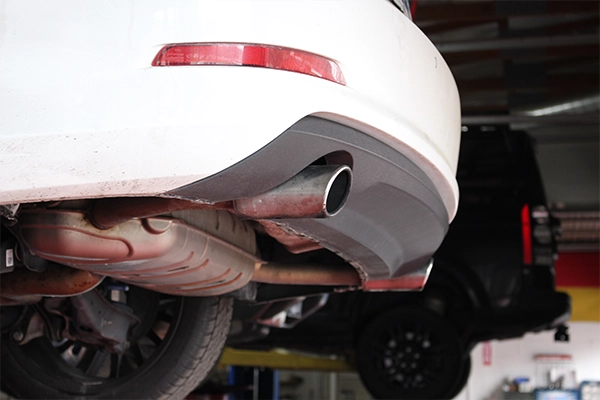
With all these different purposes and parts, there’s a lot of room for failure. As your metal exhaust components are exposed to water, salt, rocks, and debris, they can begin to wear down and eventually develop leaks. Not only this, but engine issues can cause failure of the catalytic converters and lead to increased engine noise, a strong smell of burning fuel, damaged oxygen sensors, and an inability to pass smog inspections.
If you notice any signs of an issue in your exhaust, you should bring your vehicle to a professional as soon as you can to avoid the worsening of the issue and increased emissions.
Signs Your Exhaust Needs Attention
- Louder engine noise, roaring, or a rumble that gets worse when accelerating
- Rattling underneath, especially at idle or over bumps
- A ticking sound near the engine that fades as it warms up (often an exhaust manifold leak)
- Exhaust or rotten-egg smell inside the cabin
- Check engine light with oxygen sensor or catalytic converter codes
- Reduced fuel economy or sluggish acceleration
An Exhaust Leak Is a Safety Issue
Exhaust contains carbon monoxide, a colorless, odorless gas. A leak under the car can let it seep into the cabin, especially when idling or sitting in traffic with the windows up. If you smell exhaust inside your vehicle or feel drowsy or lightheaded while driving, open the windows and have it inspected right away.
Salt, Rust, and Short Trips
Winter road salt eats away at exhaust pipes, hangers, clamps, and mufflers. Short trips make it worse: the system never gets hot enough to burn off moisture, so water condenses inside and rusts components from the inside out. That’s why exhaust repair is so common across Chicago’s Southland and Northwest Indiana.
Exhaust Services We Provide
Our ASE-certified technicians repair and replace mufflers, resonators, pipes, hangers, flex pipes, exhaust manifolds and gaskets, oxygen sensors, and catalytic converters. We’ll inspect the whole system, show you what’s leaking or loose, and recommend a repair that fits your vehicle and budget.
Exhaust Service at Scott’s U-Save
Having exhaust issues? Call or schedule online with us today! Our expert ASE-Certified technicians can repair your car and get it back on the road quickly. Whether you have a failed catalytic converter, faulty oxygen sensor, or a rusted-out muffler, the teams at our four locations in New Lenox, IL; Schererville, IN; Steger, IL; and Crown Point, IN know the ins and outs of exhaust repair.
Frequently Asked Questions
Is it safe to drive with a loud exhaust?
It’s not recommended. A loud exhaust often means a leak, which can allow carbon monoxide into the cabin. It can also cause a failed emissions test and damage oxygen sensors.
What causes a catalytic converter to fail?
Converters usually fail because of an engine problem upstream, such as misfires, oil burning, or a rich fuel mixture that overheats or clogs them. We’ll look for the root cause so a new converter doesn’t fail the same way.
What’s that rattle under my car?
Often it’s a loose heat shield, a broken hanger, or a failing converter with loose internals. A quick inspection on a lift usually finds it fast.
Can you repair just one section of my exhaust?
In many cases, yes. If only a pipe, hanger, or muffler is damaged, we can often replace that section rather than the whole system.
Will an exhaust leak affect my check engine light?
It can. A leak ahead of an oxygen sensor can skew its readings and set codes. Fixing the leak often resolves the light.